What Is A Candlestick Chart?
Mar 29, 2023
Trading has always been a smart way to earn passive income. Commodities, cryptocurrencies, foreign exchange, stocks, etc., are just some of the many assets traded in today’s market. But trading is not a piece of cake, and simple investing does not always bring high returns. Analyzing the market, understanding the trends, and acknowledging the factors that could affect prices are all necessary for successful trading.
This is where charts and graphs come in handy. These visual representations of price movements are incredibly useful in making accurate trading decisions. They form patterns that tend to repeat, and traders who acknowledge these patterns can often profit handsomely.
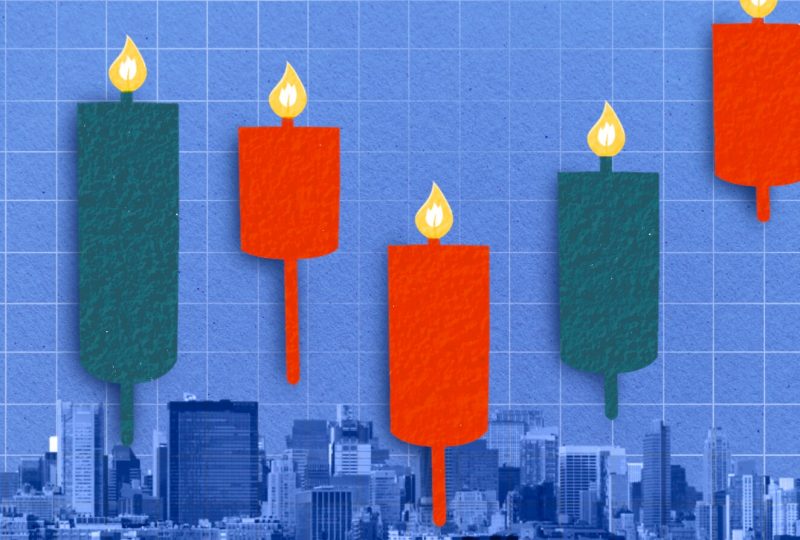
Candlestick charts are one of the most commonly used charts, with candle-shaped figures and coloured bodies helping traders to easily perceive the market movement.
Let’s discuss the idea of candlesticks and how you can use them for successful trading decisions.
Key Takeaways
- Candlestick charts are one of the most widely used types of financial charts as they offer a quick and visually easy way to understand the market.
- A Candlestick chart can provide valuable insights into price movement, as besides open price, close price, high price, and low price, it indicates market sentiment and traders’ emotions.
- Over 70 unique candlestick price patterns have been identified, each indicating bullish or bearish trends.
- While candlestick patterns can be a valuable tool for predicting market direction, past performance is not always an indicator of future results. Therefore, investors should always manage risks and invest the amount they afford to lose.
Origin Of Candlestick Charts
Rice price analysis from the 18th century represents some of the earliest examples of technical analysis of trading. Munehisa Homma, a rice merchant from Sakata, Japan, who worked the Ojima Rice market in Osaka during the Tokugawa Shogunate, is widely credited as the inventor of candlestick charting.
He came to the conclusion that the price of rice, the supply and demand, and the emotions of traders were all interconnected in some way. He devised a chart in which each candlestick represented one of the four dimensions that make up a trading period: the open, the high, the close, and the low, respectively. Steve Nison’s book, Japanese Candlestick Charting Techniques, was first published in 1991 and is credited with introducing candlesticks to the Western world for the first time.
How Do Candlesticks Differ From Other Charts?
Although traders are familiar with a wide variety of bar charts, and graphs, Candlesticks are frequently the preferred choice because of the visual clarity they provide. This is because the charts’ colour coding of price bars and thicker real bodies better highlight the difference between the opening and closing prices.
For instance, traditional line charts for foreign exchange, stocks, or other securities typically display a single line whose Y (price) fluctuates up and down as the line steadily moves to the right relative to the X (time). In other words, a single line illustrates a security’s price change over time. Depending on the parameters of the chart, a line chart can show the price of a security hour-by-hour, daily, or even minute-by-minute.
The Candlestick chart is similar to the line chart. Still, instead of a continuous line, it displays a single candlestick per unit of time, each containing the five pieces of information – open, close, high, low, and whether the security went up or down in price. One candle on a candlestick chart could represent an entire day, week, or month or an hour, minute, second, etc.
In other words, while the line chart merely shows how prices have changed over time, the candlestick chart reveals how prices have fluctuated throughout the day (or other units of time) by displaying high and low prices in addition to open and close prices.
Although we can not predict the future based on the past, history repeats, and market behavior can sometimes be somewhat predictable. Therefore, specific candlestick patterns have become handy tools for making profitable buy and sell decisions.
Reading The Candlestick Charts
The standard candlestick chart includes four points. The high and low points represent the highest and lowest prices, respectively, during the given time interval. Opening prices are those listed first, and closing prices are those listed last. Additionally, the candlestick has three important elements expressing different things:
- Real Body
In this context, “body” refers to the range of values between an asset’s open and close price. The candlestick body tells investors whether the closing price was higher or lower than the opening price. The market is bullish when the closing price is higher than the opening and bearish when the opposite is.
- Wick/Shadow
Usually, but not always, there are two “shadows,” or wicks, in each candlestick chart. The shadows represent the price’s high and low for a given period. Consequently, the upper shadow represents the highest price point, and the lower shadow represents the lowest price traded in the given time. Occasionally, only one of the shadows may be visible. It occurs when the open and close coincide with the high or low.
- Candle Color
The candle’s color can indicate the direction of the possible price movement. A green (or white) candlestick body typically shows an upward price trend, while a red (or black) means a declining trend. On most platforms, you will most likely witness green and red bodies.
Most Popular Candlestick Patterns
There are various candlestick patterns, with some having higher probabilities of being correct than others. They can be either bullish or bearish patterns. Several of the most fundamental are listed below.
Bullish Patterns
After a downward trend in the market, bullish patterns may emerge. They signal to investors that it may be worthwhile to open a long position in preparation for a possible upward trend. Here are a few of the most popular bullish patterns.
Hammer
Candles in the shape of a hammer have a green (white) body, a long lower wick, and a short or nonexistent upper wick. This pattern appears at the end of a downward trend and indicates that buyers regained control of the market and drove the security price back above its opening price by the end of trading.
Bullish Engulfing
Occasionally, a bullish engulfing will form at the end of a downtrend, a two-candlestick pattern that can signal a trend reversal. The pattern’s initial candle is red with a low price point and a small real body. The following day’s candle is green, has a much longer real body, and opens at a lower price than the previous day.
Morning Star
Sometimes at the bottom of a downtrend, a three-candle pattern known as a morning star will form, suggesting a possible trend reversal. The real body of the first candle, which is red, is quite long. The second candle could be either red or green, but its extremely short body and upper and lower wicks give it the appearance of a star. The long green real body of the third candlestick indicates that purchasers are steering the security in an upward direction.
Piercing Line
Also a two-stick pattern, the piercing line is composed of a long red candle followed by a long green candle.
Typically, when one candlestick ends and the next begins, the green one opens with a sizable price drop. When the price is driven to or above the day’s middle point, it indicates a significant amount of buying pressure.
Three White Soldiers
The pattern of three white soldiers occurs over three days. It consists of successive long green (or white) candles with small wicks that open and close higher than the day before.
After a downward trend, this is a very bullish sign because it indicates that buying pressure is increasing.
Bearish Patterns
A bearish pattern indicates that prices will soon decline. Here are a few of the most common bearish patterns one should be familiar with to make the right trading decisions.
Hanging Man
The hanging man pattern is the exact opposite of the hammer pattern. It happens when an uptrend is ending, and it could be an indicator of a trend reversal. Candles shaped like a hanging man are red and have a short real body and a long lower wick to represent a significant selloff during the trading day that buyers later reversed.
Bearish Engulfing
Basically, a bearish engulfing pattern is the opposite of a bullish engulfing pattern. Two candles forming at the peak of an uptrend may indicate the beginning of a trend reversal. One candle is green with a relatively brief real body, while the other is red and has a much more extended one. With this formation, the second candle typically has a higher opening price than the first.
Evening Star
Compared to a morning star, a bearish evening star pattern is the opposite. The appearance of a three-candle pattern at the peak of an uptrend may signal a reversal. The first candle is green and has a relatively long body. The second candle, which can be either red or green, has an extremely short real body and two wicks, giving it the appearance of a star. The third is coloured red and has a long body, indicating that sellers outnumber buyers and control the security’s direction.
Dark Cloud Cover
The dark cloud covering the candlestick pattern signifies a bearish reversal – a dark cloud over the optimism of the previous day. It consists of two candlesticks, one green, and one red. The red candlestick opens higher than the green one and closes lower than its midpoint.
It means the bears have taken control of the session and are driving prices down. If the wicks of the candlesticks are short, this indicates that the downward trend was extremely intense.
Three Black Crows
When three long red candles with short or nonexistent wicks are arranged in a row, they form the three black crows candlestick pattern. Though the opening price of each trading day is similar to that of the previous day, the persistent selling pressure causes the price to fall throughout the trading day.
Since sellers have outpaced buyers on three consecutive trading days, this formation is the beginning of a bearish downtrend.
Doji Candlestick
A candlestick pattern is considered a continuation pattern if it does not signal a reversal in market momentum. Investors can use these to spot a time of relative calm in the market when prices aren’t moving significantly in either direction. The Doji pattern is a good illustration of a continuation pattern.
Doji candles are those that appear to have no real body at all or very little. The prices at the beginning and end of the day (or period) were very similar. When a Doji candlestick appears at the end of an up or downtrend, it forms a morning star or evening star pattern, respectively.
Doji has three types, dragonfly, gravestone, and long-legged.
The dragonfly pattern appears when there is no real body, the bottom wick is long, and the top one is small. This demonstrates that people prefer to pay higher prices and are unwilling to accept lower ones.
Gravestone occurs when the top wick is long and the bottom wick is short, indicating that the market is rejecting a higher price.
The long-legged candlestick pattern, characterized by two long wicks, indicates that the direction of the trend is uncertain.
FAQs
- What are candlestick charts used for?
Traders analyze candlestick charts to forecast future price changes based on existing ones. Candlesticks are a helpful tool for traders because they display open, close, high, and low prices and express market sentiment over the chosen time period.
- Do candlestick patterns matter?
Candlestick patterns serve as a powerful market analysis tool, and studies have approved that certain candlestick patterns are highly predictive and can lead to profitable trades.
- Which candle is the most bullish?
Some of the most accurate bullish candlestick patterns include the hammer, bullish engulfing, and the morning star.
The Bottom Line
Candlestick charts are a reliable tool when analyzing market trends and price movements. Yet again, past performance does not guarantee future results, and Candlesticks are not always 100% accurate, meaning the traders should always invest the amount of capital they afford to lose.
Subscribe Our Newsletter

Constantine
Hanging Man Pattern: How to Identify and Trade It EffectivelyMarkets have a unique way of communicating — and the shapes of candlesticks are among their most telling indicators. The hanging man pattern, while appearing as a subtle hint, frequently indicates something significant: a possible shift in direction. It’s a small candlestick on the chart that conveys a powerful message — a caution that the […]
Trading
Alexander
How Renewable Energy Stocks Can Supercharge Your PortfolioRenewable energy is booming. Check out the best renewable energy stocks and top investment opportunities in the clean energy sector.
Investing

After the government revealed that consumer prices were running at an all-time high in January, 10-year Treasury rates finally crossed the psychologically important 2% mark on Thursday, sending equities into a spiral.
Banks and Finance