Microsoft Is Bringing Call of Duty to Nintendo, Putting Sony on Notice.

Dec 08, 2022

Microsoft_Is_Bringing_Call

As it seeks to alleviate regulatory worries over its proposed acquisition of video game maker Activision Blizzard, Microsoft has agreed to give competitor Nintendo access to the blockbuster series Call of Duty for a decade.

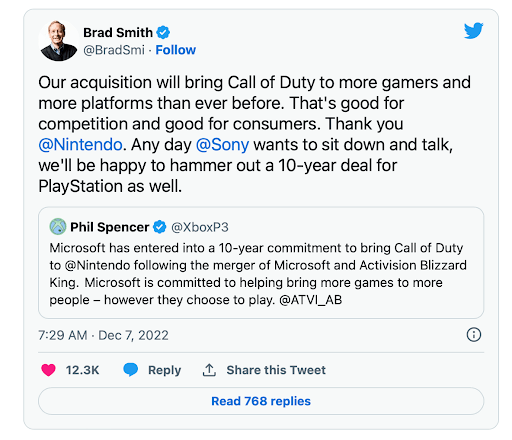
"Microsoft and Nintendo made a 10-year commitment to release Call of Duty on Nintendo following the merger between Microsoft and Activision Blizzard King. Both Xbox and Nintendo are committed to helping bring more games to more people - no matter what they choose to play," said a Microsoft spokesperson.

The move may resolve some of Sony's concerns, which has asked regulators to stop the acquisition on competition grounds.

In practice, Microsoft's offer to Nintendo is little. The Japanese firm has mostly avoided violent shooter titles on its Switch device, reducing the number of customers likely to benefit from the deal. The last big Call of Duty game released on the Nintendo console was in 2013.

However, the idea of a similar 10-year arrangement for access to Call of Duty with Sony, as mentioned by Microsoft's vice chairman Brad Smith on Wednesday, represents a new public front in the company's efforts to satisfy antitrust regulators surrounding the $75 billion plan to purchase Activision Blizzard (ATVI)
https://liquidity-provider.com/app/uploads/2022/12/unnamed-5.png

Of course, Sony has been the most aggressive opponent of the deal. It has stated that Microsoft's decision to exclude Call of Duty from Sony's PlayStation platform might hurt customers. Sony also had said in submissions to UK authorities that Microsoft had only offered to make Activision's games available on PlayStation until 2027.

Additionally, Sony shared its concerns about Microsoft leveraging Activision Blizzard because Microsoft will use the game-making company to boost the attractiveness of its multigame subscription packages, and, eventually, cloud-gaming services.

Investors were skeptical Wednesday that Microsoft's words would tip the balance for regulators, notably the Federal Trade Commission, as they will weigh approving the Activision Blizzard purchase. And that's why Activision Blizzard shares were trading at $76, significantly below the $95 takeover price.

But this time, the Federal Trade Commission's approach to the Microsoft-Activision Blizzard merger is poised to take a harder position on such transactions involving vertical mergers or mergers between firms that do not compete directly. According to Chairwoman Lina Khan, there were too high expectations of the business performance of such mergers without fully recognizing the potential harm. That's why last year, the guidelines introduced under former President Donald Trump were reversed, making the merger of two companies even more complicated. Bloomberg reported that Microsoft executives intend to meet with Khan and other FTC officials on Wednesday.

Subscribe Our Newsletter

South Korean CBDC – 7 South Korean Banks to Join Issuing The Digital Currency Since cryptocurrencies arrived on the financial scene and changed how people transact and transfer money, central banks have become more interested in developing their own virtual payment systems. After Russia, China, Nigeria, India, and Jamaica, South Korea is taking a major step toward introducing its own Central Bank Digital Currency in an upcoming pilot program involving the public and some major banks. The initiative aims to test the feasibility of a digital currency within the existing financial system, enabling a limited number of citizens to transact with CBDC at selected merchants and Points of Sale. This move aligns with the global trend of central banks exploring digital currencies to enhance payment efficiency, reduce transaction costs, and modernize the financial landscape. South Korea CBDC Pilot Program Bank of Korea (BOK), in collaboration with financial regulators, announced an initiative to test the rolling out of CBDC involving seven major banks and 100,000 participants. The pilot program “Project Hangang” is scheduled to run from April to June 2025, focusing on testing deposit tokens issued by banks and backed by the CBDC. These banks include KB Kookmin Bank, Shinhan Bank, Hana Bank, Woori Bank, NH NongHyup Bank, Industrial Bank of Korea (IBK), and Busan Bank. These tokens will be used for transactions in both online and offline retail environments, allowing the government and financial institutions to evaluate their effectiveness. Users and Merchants Participation The BOK is expected to announce the project by the end of March, asking 100,000 South Koreans to participate in the pilot and convert their traditional bank deposits into digital tokens for payments. Individuals will be limited to a maximum holding of 1 million WON (approximately $687) and a total transaction cap of 5 million WON during the trial’s duration. Various merchants, including convenience stores, supermarkets, coffee shops, and online platforms, will accept these tokens as payment. Notable participants include 7-Eleven, Hanaro Mart, Ediya Coffee, Silla University, and Hyundai Home Shopping. This will help assess the practicality and usability of the CBDC across different retail settings. Global Adoption of CBDC The South Korean CBDC initiative is part of a broader global trend, with many countries exploring digital currencies to modernize their financial systems. The Bank for International Settlements (BIS) has been actively promoting CBDC projects worldwide, with major economies such as China, the European Union, and the United States conducting their own trials. China’s digital Yuan e-CNY is already in an advanced phase, with widespread adoption in various sectors. The European Central Bank is also working on a digital Euro, while the US Federal Reserve is researching the potential implications of a digital Dollar. These initiatives aim to improve payment efficiency, enhance financial inclusion, and strengthen monetary policy frameworks. Conclusion South Korea’s CBDC pilot marks a significant step toward digital financial transformation. By involving the public, key banking institutions, and merchants, the trial will offer critical data on the viability of digital currencies. As more countries explore CBDCs, these findings could influence future implementations worldwide, paving the way for a more efficient payment system.

Hazem

South Korean CBDC – 7 South Korean Banks to Join Issuing The Digital Currency

South Korean CBDC will be tested in a Central Bank-led pilot project involving 100,000 users and 7 issuing banks. Here’s what we know about this project.

Crypto
Meta Stock Price Prediction 2040

Nato

Meta Stock Price Prediction 2040: META’s Impressive Rally

Meta Stock Price Prediction 2040 - Explore META's earnings power, valuation, and competition in this in-depth analysis.

Companies
B2BROKER Liquidity B2BROKER Liquidity
Sponsored
Сonstantine

Internal vs External Range Liquidity In ICT Trading Explained
Every trader at some point asks: Why did the price spike right before my stop-loss hit? Or why does it reverse just after breaking a major level? If you’ve been there, you’re not alone—and you’re closer to discovering the truth behind price action than you think. In the ICT methodology, the answer lies in one […]

discover
what is a spot etf

Alexander

Why Is Bitcoin Spot ETF Approval Such a Big Deal?

A Bitcoin spot ETF is a type of investment that tracks the price of BTC in the crypto market. How does the approval of these assets affect the financial world?

Blockchain
Contact us bg

Contact Us

Contact the Liquidity Provider
for any questions and advertising inquiriesb2broker

    Please fill out this contact form to get in touch with us

    / 3000

    By clicking “Get in touch” button, you agree to the privacy policy

    Successful!
    Thank you for your request.
    We will contact you shortly.
    Close

    Deborah Middleton

    Understanding Loan Options for Different Financial Situations

    Understanding Loan Options for Different Financial Situations

    Constantin

    How to Create a Website for a Liquidity Provider: Guide 2026

    Create website for liquidity provider

    George

    Best XRP Alternatives Under $5 Right Now: Affordable Coins With Real Growth Potential

    Top XRP Alternatives Under $5 (2025): Low-Cost Coins With Big Growth Potential

    Hazem

    MetaTrader vs cTrader: Which Trading Platform Shall You Choose?

    MetaTrader vs cTrader: The Full Breakdown

    Сonstantine

    Will Dogecoin Reach $1? Tokenomics and Price Analysis

    Will Dogecoin Reach 1 Dollar Analysis

    Сonstantine

    How to Get a Crypto Exchange License?

    How to Get Crypto Exchange License

    Сonstantine

    Best Crypto to Buy Now: Guide for Investors

    Best Crypto To Buy Now

    Hazem

    Grok vs ChatGPT: What’s the Best AI Assistant You Need in 2025

    Grok vs ChatGPT

    Сonstantine

    How to Choose the Right Liquidity Provider for Your Brokerage

    How to Choose the Right Liquidity Provider for Your Brokerage

    Сonstantine

    Low-Latency Trading Defined: Speed, Strategy and Technology

    Low-Latency Trading Explained

    Hazem

    How Liquidity Depth Affects Slippage in High-Volume Trading

    Liquidity depth and slippage in trading

    Hazem

    What is FIX API Liquidity Connection and How Does it Power Institutional Trading?

    FIX API in institutional trading

    Сonstantine

    OTC Trading Strategies and Technologies to Succeed in Over-the-Counter Markets

    OTC Trading Strategies

    Alexander

    What is OTC Trading? A Complete Guide for 2025

    what is OTC

    Alexander

    Synthetic Futures: A Trader’s Guide to Replicating Positions with Options

    How to Trade Synthetic Futures

    Сonstantine

    Order Book Depth: What It Is And Why It Matters?

    Order Book Depth What It is And Why It Matters

    Alexander

    Spot vs Perpetual Futures: Which Is Right for You?

    Spot vs Perpetual Futures explained

    Hazem

    5 Reasons Traders Are Switching to Perpetual Futures

    5 Reasons to Switch to Perpetual Futures

    Constantine

    Top 3 Liquidity Challenges Facing New Exchanges and How to Solve Them

    Top 3 Liquidity Challenges Facing New Exchanges Today

    Constantine

    Financial Planning in the Cryptocurrency Era — Master Crypto and Digital Asset Strategies

    Financial Planning in the Cryptocurrency Era

    Hazem

    Best Platforms to Trade Perpetual Futures in 2025

    Best platforms to trade perpetual futures in 2025

    Alex

    Top 10 Fintech Website Development Agencies for 2025

    Best Fintech Website Development Agencies for 2025

    Сonstantine

    Internal vs External Range Liquidity In ICT Trading Explained

    Internal vs External Range Liquidity In ICT Trading

    Constantine

    Portfolio Backtesting — Tools, Metrics, and Methods Explained

    Portfolio Backtesting
    liquidity-provider-logo
    • News
      • Stock Market Forecast
      • Stocks
      • Banks and Finance
      • Companies
      • Crypto
      • Forex
      • AI
      • Technology
      • DeFi
      • NFT
    • Articles
      • Crypto Payments
      • Trading
      • Crypto Exchange Business
      • Forex Business
      • Fintech
      • Liquidity
      • FinTech Awards
      • Blockchain
      • Investing
      • NFT
      • DeFi
    • More
      • Videos
      • Liquidity Providers List
      • Crypto Payment Providers
      • White Label Brokerage Platforms
      • Broker CRM Platforms
    [email protected]

    © 2024 Liquidity Provider. All Rights Reserved

    Privacy Policy Cookie Policy Website developed by WSA.design
    This site is registered on wpml.org as a development site. Switch to a production site key to remove this banner.